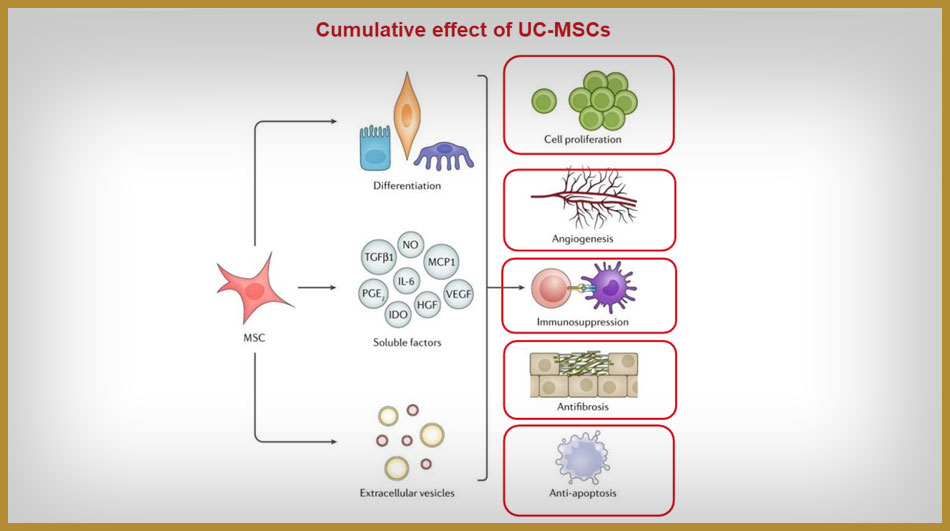
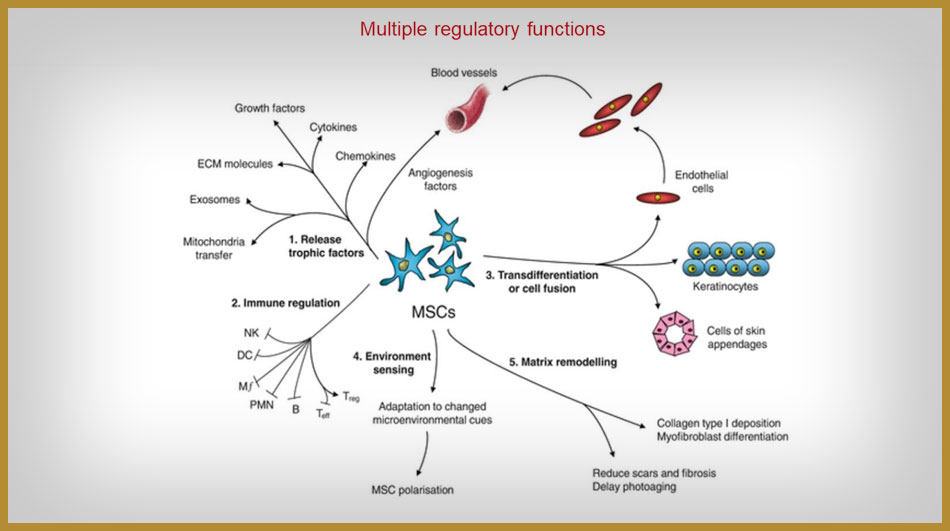
Class of multifunctional stem cells isolated and cultured from umbilical cord.
Properties:
Low-immunogenicity phenotype permits the use of allogeneic cells for patients and strongly reduces the risk of allograft rejection. No immunosuppressive therapy is needed.
Provide damaged tissue with a relatively stable environment, which is beneficial for tissue repair. Capable of polarized differentiation.
Fibrosis - excessive deposition of extracellular matrix (ECM) components, including collagen, proteoglycan, fibronectin, etc.
Physiological fibrosis is protective in response to the injury.
Pathological outcomes of progressive fibrosis due to a range of causes/triggers usually lead to fibrogenic scarring of tissues.
Fibrotic effect:
Anti-fibrotic:
Angiogenesis, the formation of new blood vessels, is a vital process in tissue wound healing that is a targeted by many pharmacologic agents to treat disorders such as myocardial ischemia, ischemic stroke, and diabetic retinopathy.
Preclinical studies in cardiac and brain ischemia support the concept that UC-MSCs improve structural and functional outcomes by repairing and stimulating the growth of blood vessels. The angiogenic properties of MSCs are mediated through the release of:
The ability to repair vascular injury after administration of MSCs has been supported in studies of:
All this properties determine the benefits and mechanisms of treatment in various diseases
After several decades of preclinical research, over 1000 clinical trials, and tens of thousands of patients, MSCs have exhibited an excellent safety record. Of these cells, the growth in interest for clinical uses of MSCs with umbilical cord origin (UC-MSCs) has been the most prolific of all.
One of the main causes of acute respiratory distress syndrome in coronavirus disease 2019 (COVID-19) is cytokine storm, although the exact cause is still unknown. Umbilical cord mesenchymal stromal cells (UC-MSCs) influence proinflammatory T-helper 2 (Th2) cells to shift to an anti-inflammatory agent.
To investigate efficacy of UC-MSC administration as adjuvant therapy in critically ill patients with COVID-19, conducted a double-blind, multicentered, randomized controlled trial at four COVID-19 referral hospitals in Jakarta, Indonesia has been done.
Results:
Another clinical trial (NCT04288102) also illustrated positive effects of UC-MSCs on lung damage in severe COVID-19 patients.
101 severe COVID-19 patients with lung damage were recruited and randomly divided at a 2:1 ratio. 66 patients received three doses of 4 × 10⁷ cells UC-MSCs intravenously on Day 0, 3, and 6, while 35 patients received placebo infusions.
Results:
Patients in the UC-MSCs group demonstrated significantly reduced the proportions of solid component lesion volume with median difference of -15.45%.
The six-minute walking distance was also 27 m longer in the treatment group.
The patients with MS were recruited and treated with UC-MSC. After treatment, the clinical therapeutic effects including symptoms, vital signs, clinical attacks, magnetic resonance imaging (MRI), neurological function scores and adverse reactions such as fever, dizziness, and vascular irritation were monitored and evaluated. In addition, the regulatory effects of UC-MSC on immune system of patients were also assessed.
Results:
After cell treatment, the symptoms involved in unstable walking lessened, mental state, appetite, coordination ability and balance force of patient 1 were remarkably improved.
The symptoms including numbness of the right limbs, constipation of patient 2 were mitigated.
At the same time, mental status and memory of patient 2 were also improved, indicating the patient’s condition was stable.
However, the symptoms and vital signs of patient in control group did not improve.
A case of a 4-year-old boy with abnormalities of muscle tone, movement and motor skills, as well as unstable gait leading to frequent falls. The results of the electroencephalogram (EEG) indicate moderately abnormal EEG, accompanied by irregular seizures. Based on these clinical characteristics, the patient was diagnosed with cerebral palsy (CP).
The patient was treated with umbilical cord mesenchymal stem cell (UC-MSC) transplantation therapy.
Results:
After three successive cell transplantations, the patient recovered well and showed obvious improvements in EEG and limb strength, motor function, and language expression.
Patients who were aged between 3 and 7 years with a confirmed diagnosis of ASD were enrolled. All children at Hospital who had severe ASD (Childhood Autism Rating Scale [CARS] scores >60) were recruited for this study.
Results:
The treatment of ASD using uncultured UC-MSCs has improved the symptoms of ASD. Particularly, ASD patients increased social participation, building relationships, and verbal communication ability to form relationships with other people.
UC-MSCs are strongly expanding candidates for a high unmet medical need in treat wide range of conditions, regenerative medicine, largely due to their regenerative characteristics such as self-renewal, secretion of trophic factors, and the capability of inducing mesenchymal cell lineages.
UC-MSCs also possess homing and trophic properties modulating immune system, influencing microenvironment around damaged tissues and enhancing tissue repair, thus offering a broad perspective in cell-based therapies.
Mesenchymal stromal cells, or MSCs, are multipotent cells found in various tissues in the body, including bone marrow, adipose tissue, and umbilical cord tissue.
Mesenchymal stem cells are rich source of biologically active anti-inflammatory and regenerative molecules.
MSCs have immunomodulatory, anti-inflammatory, and angiogenic properties that eventually promote tissue regeneration.
MSCs exert their effects by secreting cytokines, growth factors, and intercellular communication. Besides secretion and direct contact with target cells, MSC release various bioactive compounds via extracellular vesicles—small particles filled with various biomolecules and surrounded by a single lipid bilayer membrane. Such extracellular vesicles are knows as exosomes and poses the same effective therapeutic properties of the MSC at a fraction of a cost.
There are several types of extracellular vesicles. Microvesicles are over 200 nm in diameter and are created by exocytosis from the cell membrane. Exosomes are smaller than 200 nm, and they are a product of multi-stage process of endosome processing. Filled with the multitude of anti-inflammatory and regeneration promoting molecules, such extracellular vesicles provide a good alternative to live MSC cell therapy for rejuvenation, cosmetics and local mesotherapy use. A more concentrated formulations may also be considered for IV injections.
Exosomes play significant role in a variety of cell-to-cell interaction pathways associated with numerous physiological and pathological functions.
Exosomes are secreted by many different healthy cell types, but main source of exosomes for therapeutic use - Mesenchymal Stem Cells (MSTs derivate Exosome).
Recent investigations implied that the pleiotropic effects of MSCs is not associated to their ability of differentiation, but rather is mediated by the secretion of soluble paracrine factors.
MSCs secrete more exosomes than other cells.
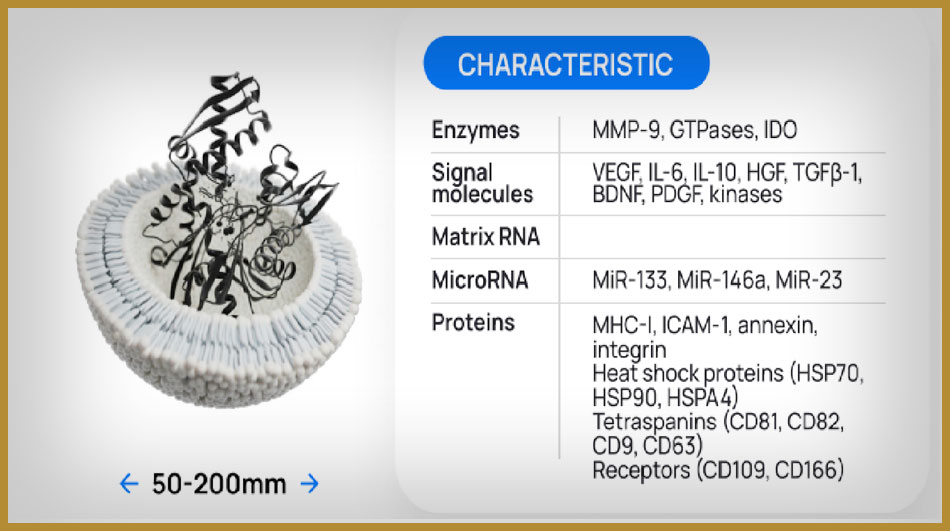
The membrane of exosomes contains lipids that aid in membrane fusion with the target cell. Important transmembrane proteins include fusion proteins, cell adhesion molecules, major histocompatibility complexes, and integrins. One example is CD44, a hyaluronic acid receptor that is crucial for exosome migration into the intercellular matrix of the injured tissues. This property is a real biotechnological term for cosmetic treatments and treatment of skin conditions.
The inner cavity contains various micro-RNAs, heat shock proteins, enzymes, and signaling molecules. Once secreted, exosomes transmit signals to target cells by binding their surface receptors or fuse with their membrane, releasing their contents into the cell’s cytoplasm. Therefore MSC derive exosomes are considered as unique targeted delivery systems.
The mRNA packed within exosomes can be translated after entering into the recipient cells. By contrast, microRNA is involved in RNA silencing and posttranscriptional regulation of gene expression in recipient cells. Thus, exosomes are one of the pathways through which MSCs realize their therapeutic effect, and they can be separated and used as a standalone cell-free product.
They are similar to MSCs in their low immunogenicity and ability to reduce inflammation, modulate the activity of immune cells, and migrate to the injured site, such as a stroke lesion.
Naturally, their content depends significantly on the condition of the source MSCs because these cells are highly responsible to the cues from the microenvironment, both in vitro and in vivo.
In addition to that, they have a number of advantages.
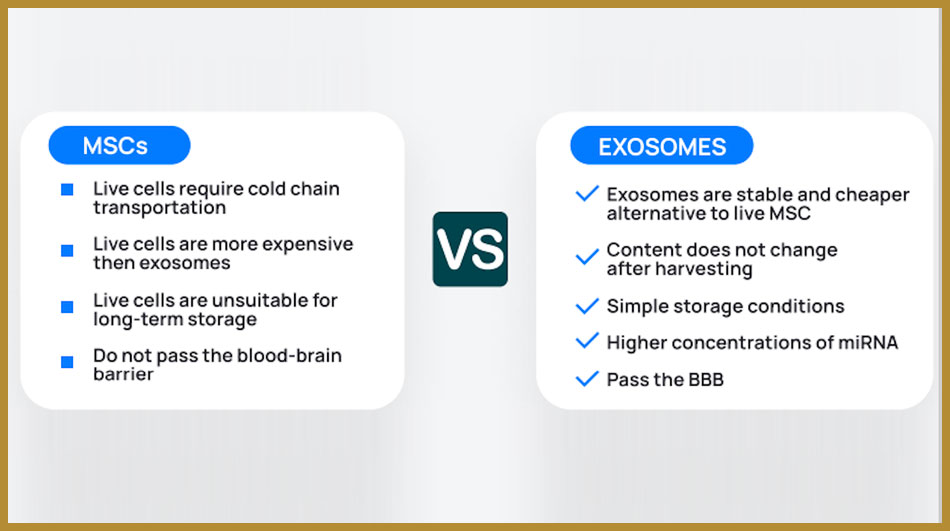
Firstly, a cell-free product is good for several reasons. Comparing to live mesenchymal stem cells, exosomes are suitable for long term storage without loss of their regenerative, anti-inflammatory and stimulatory properties.
And they are more stable compared to MSCs because, unlike cells, exosomes cannot change their cytokine and enzymatic profile after secretion.
Secondly, exosomes contain high concentrations of miRNA – small regulatory RNAs that regulate the translation and transcription of specific mRNAs. Micro-RNAs are small single-strand RNAs that bind the 3’ or 5’ untranslated regions of specific matrix RNAs, or with promoters of certain genes. The result is selective mRNA degradation, inhibited translation, or regulation of transcription. Micro-RNA-dependent pathways are often involved in the pathogenesis of many diseases, so exosomes add yet another opportunity to reverse the pathological process.
Also, exosomes can pass the blood-brain barrier due to their small size. It is especially valuable in stroke and chronic brain diseases.
Most of the pathological disease processes develop chronic inflammation of the associated tissues that results in activation of immune responses and eventually leads to degeneration via several compensatory mechanisms.
Reduction of the local inflammation is a key to the tissue regeneration and mesenchymal stem cells derived exosomes are ideal candidates for such therapy.
How exactly do exosomes work in the nervous system?
Studies have shown that all the signal molecules and microRNAs have a regenerative and anti-inflammatory effect. Most importantly, they stimulate the differentiation of neural progenitor cells into mature neurons in substantia nigra via brain-derived neurotrophic growth factor signaling.
They send survival signals to existing neurons, preventing their apoptosis.
Exosomes also reduce neuroinflammation, which is heightened in Parkinson’s, by switching the microglia to an anti-inflammatory phenotype and decreasing the synthesis of reactive oxygen species in immune cells and astrocytes. Besides, their endothelial growth factors stimulate the growth of blood vessels, which degenerate when neurons die.
Osteoarthritis
Mesenchymal stromal cells are known to decrease inflammation, promote cartilage regeneration, reduce pain, and improve the functionality of the joints in osteoarthritis.
Such effects are achieved by mesenchymal paracrine factors. The same cocktail of factors is contained in exosomes, providing a cheaper and more concentrated alternative to live MSC.
Cardiovascular diseases
Stroke, myocardial infarction, peripheral arterial disease, and atherosclerosis - remain a significant cause of mortality and disability. In most cases, an acute episode such as a stroke is preceded by gradual deterioration of the vasculature, mostly due to cholesterol accumulation in the arteries and the resulting inflammation and clogging.
MSCs and exosomes could both slow down the chronic stage and accelerate recovery after an acute episode.
Crohn’s disease
Crohn’s disease is an autoimmune condition characterized by persistent inflammation of the intestines. Every third patient develops fistulas, which are often resistant to both surgical and pharmacological interventions. MSCs or their exosomes could alleviate this inflammation to achieve long-term fistula healing and improvement in the quality of life.
Acute respiratory distress syndrome (ARDS)
During the COVID-19 pandemic, MSC attracted interest as a pleiotropic agent against the cytokine storm, a life-threatening systemic inflammation caused by severe viral infection. RNA multiplication inside host cells, T-cell and macrophage activation in response to the virus, and evasion of immune response create a vicious circle of intensifying inflammation.
BM-MSC were found to be safe for COVID patients with acute respiratory distress syndrome, but exosomes could be even safer because of their zero risk of teratogenesis and clumping/embolism. MSC exosomes have what is needed to stop the cytokine storm in severe COVID-19 or other acute lung disease.
To conclude, exosomes are one of the key mechanisms of action of mesenchymal stromal cells, which makes them a safe but still effective alternative to cell therapy.
They are helpful whenever excessive inflammation leads to disease: neural degeneration, cardiovascular diseases, inflammatory bowel disease, osteoarthritis, or acute pneumonia.
Exosome therapy is a new frontier in regenerative skincare and anti-aging medicine.
Used for a long time for the treatment of skin diseases such:
Exosomes have become the ultimate alternative and new favorite Skin-Rejuvenation Treatment.
Skin changes are among the most visible signs of aging.
Most Common Anti-Aging Treatments:
In contrast to other methods, exosomes affect the pathway thus preventing manifestations of changes.
MSC-derived exosomes contribute to the result by several mechanisms:
Advantages of MSC-derived exosomes for regenerative therapy:
Recommendations for use:
MICRONEEDLING: Microneedling is a technique that involves using tiny needles to create small punctures in the skin. This stimulates collagen production and enhances the absorption of topical treatments, including exosomes applications.
LASER THERAPY: Laser therapy can be used to improve skin tone, reduce the appearance of wrinkles and fine lines. Laser therapy also promotes collagen production. When combined with exosomes, laser therapy can help to maximize the rejuvenating effects of the treatment.
PLATELET-RICH PLASMA (PRP) THERAPY: PRP therapy involves injecting a concentrated solution of the patient's own platelets into the skin to promote tissue repair and regeneration. When combined with exosomes, PRP therapy can help to enhance the healing and Revitalizing impact of the skincare procedure.
MESOTHERAPY: Mesotherapy involves injecting a cocktail of vitamins, minerals, and other nutrients into the skin to improve its health and appearance. When combined with exosomes, mesotherapy can help to maximize reinvigorating outcomes of the skincare method.
CHEMICAL PEELS: Chemical peels involve applying a solution to the skin that causes the outer layer to peel off, revealing smoother, brighter skin underneath. When combined with exosomes, chemical peels can help to promote collagen production and enhance the overall restorative benefits of the skin rejuvenation process.